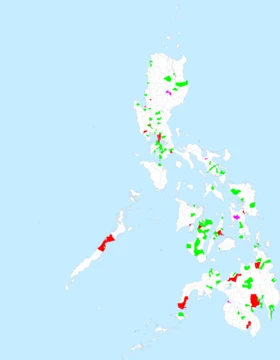
Zamboanga City
A major port city and regional hub in Mindanao.

Zamboanga City, officially the City of Zamboanga, is a highly urbanized city in the Zamboanga Peninsula region of the Philippines. It is the commercial and industrial center of the region, the third-largest city by land area in the Philippines, and the sixth-most populous city in the archipelago. As of the 2024 census, its population was 1,018,894. It is also the second most populous city in Mindanao after Davao City. Although geographically separate and governed independently, it is grouped with the province of Zamboanga del Sur by the Philippine Statistics Authority for statistical purposes, and it is the largest city of that province and in the entire Zamboanga Peninsula Region.
- population_2024
- 1,018,894
- land_area_rank
- third-largest in the Philippines
- population_rank
- sixth-most populous in the Philippines
- region
- Zamboanga Peninsula
- chartered_city_date
- October 12, 1936
- highly_urbanized_city_designation
- November 22, 1983
Verified Timeline
Lore & Background
The name Zamboanga is the Hispanicized spelling of the Sinama term for 'mooring place' — samboangan (also spelled sambuangan; and in Subanen, sembwangan), from the root word samboang ('mooring pole'). 'Samboangan' was the original name of Zamboanga City, from where the name of the peninsula is derived. A commonly-repeated incorrect modern folk etymology instead attributes the name to the Indonesian word jambangan (claimed to mean 'place of flowers', but actually means 'pot' or 'bowl'), usually with claims that all ethnic groups in Zamboanga were 'Malays'. However, this name has never been attested in any historical records before the 1960s. The city's nickname 'City of Flowers' is derived from such folk etymologies. The Zamboanga Peninsula was settled in the late 12th or early 13th century by the Subanen people. The 11th-century Chinese Song dynasty records mention a polity named 'Sanmalan' (三麻蘭) from Mindanao, which has a name similar to Zamboanga and has been tentatively identified with it by some authors (Wang, 2008; Huang, 1980). Sanmalan is said to be led by a Rajah 'Chülan'. His ambassador, 'Ali Bakti', and that of the Butuan's 'Likan-hsieh' are recorded as having visited the Chinese imperial court with gifts and trade goods in AD 1011. However, the correlation between Zamboanga and Sanmalan is based only on their similar-sounding names, and it is unknown whether Sanmalan is indeed Zamboanga. Spanish explorers, led by Ferdinand Magellan, arrived in the Philippine archipelago in 1521. Zamboanga was chosen in 1569 as the site of the Spanish settlement and garrison on La Caldera (now part of Barangay Recodo). On April 5, 1635, Cebu sent a force of 300 Spanish and 1,000 Visayan troops to settle and colonize Zamboanga City under the command of Captain Juan de Chavez. Zamboanga became the main headquarters of the Spaniards on June 23, 1635, upon approval of King Philip IV of Spain; the Spanish officially founded the city. Construction began on Fort San José (now known as Fort Pilar) to protect the inhabitants from Moro piracy. Spain was forced to abandon Zamboanga temporarily and withdraw its soldiers to Manila in 1662 after the Chinese under Koxinga threatened to invade the Spanish Philippines. The Spanish returned to Zamboanga in 1718, and rebuilding of the fort began the following year. A British naval squadron conducted a raid on Zamboanga in January 1798, but was driven off by the city's defensive fortifications. On October 12, 1936, Zamboanga became a chartered city under Commonwealth Act No. 39. It was inaugurated on February 26, 1937. Zamboanga City is an independent, chartered city and was designated a highly urbanized city on November 22, 1983. In 2028, the city's population is projected to hit the 1,200,000 population mark, which will make the city fall under the NEDA's classification of a Metropolitan City.
Reader's Guide
Zamboanga City holds significance as a historical stronghold of Spanish colonial power in Mindanao, supporting colonial efforts in the southern part of the island and paving the way for Christian settlements. It also served as a military outpost, protecting the island against foreign invaders and Moro pirates. The fort, Fort Pilar, was central to centuries of conflict between Spanish forces and Muslim polities, with several battles between Moros and Spaniards during Spanish rule from the 16th century to the 18th. The city's etymology reflects its pre-colonial roots as a mooring place for the Sama-Bajau people, while its modern status as a highly urbanized, independent chartered city underscores its economic and demographic importance. It is the commercial and industrial center of the Zamboanga Peninsula and the second most populous city in Mindanao after Davao City. The city's projected population of 1.2 million by 2028 would classify it as a Metropolitan City under NEDA standards. Its diverse cultural heritage includes influences from Subanen, Tausūg, Sama-Bajau, Spanish, and Mexican settlers, as well as Visayan laborers. During the 13th century, the Tausūg people began migrating to the Zamboanga Peninsula and the Sulu Archipelago from their homelands in northeastern Mindanao. They became the dominant ethnic group in the archipelago after they were Islamized in the 14th century and established the Sultanate of Sulu in the 15th century. A majority of the Yakan, the Balanguingui, and the Sama-Bajau were also Islamized, though most of the Subanen remained animist (except the Kolibugan subgroup in southwestern Zamboanga).
Did You Know?
- The name Zamboanga is the Hispanicized spelling of the Sinama term samboangan, meaning 'mooring place', from the root word samboang ('mooring pole').
- On April 5, 1635, Cebu sent a force of 300 Spanish and 1,000 Visayan troops to settle and colonize Zamboanga City under the command of Captain Juan de Chavez.
- A British naval squadron conducted a raid on Zamboanga in January 1798, but was driven off by the city's defensive fortifications.
- Zamboanga City was designated a highly urbanized city on November 22, 1983.
- In 2028, the city's population is projected to hit 1,200,000, which would classify it as a Metropolitan City under NEDA standards.
Frequently Asked Questions
Who is Zamboanga City?
Zamboanga City is a highly urbanized city on the Zamboanga Peninsula in western Mindanao, Philippines. It functions as a major port and the regional hub for the entire area.
What is Zamboanga City's role or 'power' in the region?
It serves as the commercial and industrial engine of the Zamboanga Peninsula, driving trade and manufacturing for surrounding municipalities. Its port infrastructure also makes it a critical gateway for goods moving through Mindanao.
How big is Zamboanga City compared to other Philippine cities?
By land area it is the third-largest city in the country, and the 2024 census counted roughly 1.02 million residents, ranking it sixth in population nationwide.
When did Zamboanga City earn its current independent status?
The city was officially chartered on October 12, 1936, and later received its highly urbanized city designation on November 22, 1983. Those two milestones separated it administratively from the surrounding province and locked in its autonomous governance.
Why is Zamboanga City important to the wider Philippines?
As the primary commercial and industrial center of western Mindanao, it anchors the regional economy and supports millions of livelihoods beyond its own borders. Its combination of port access, large population, and industrial base makes it one of the country's most strategically significant urban nodes.
More in Philippine Cities 1-18
Spotted an error? Know more?
This is a living reference — every entry is fact-audited, and reader corrections feed straight into our audit queue. Suggest an edit · See this site's audit record